Google now charges for missed Local Services Ads calls: what to change
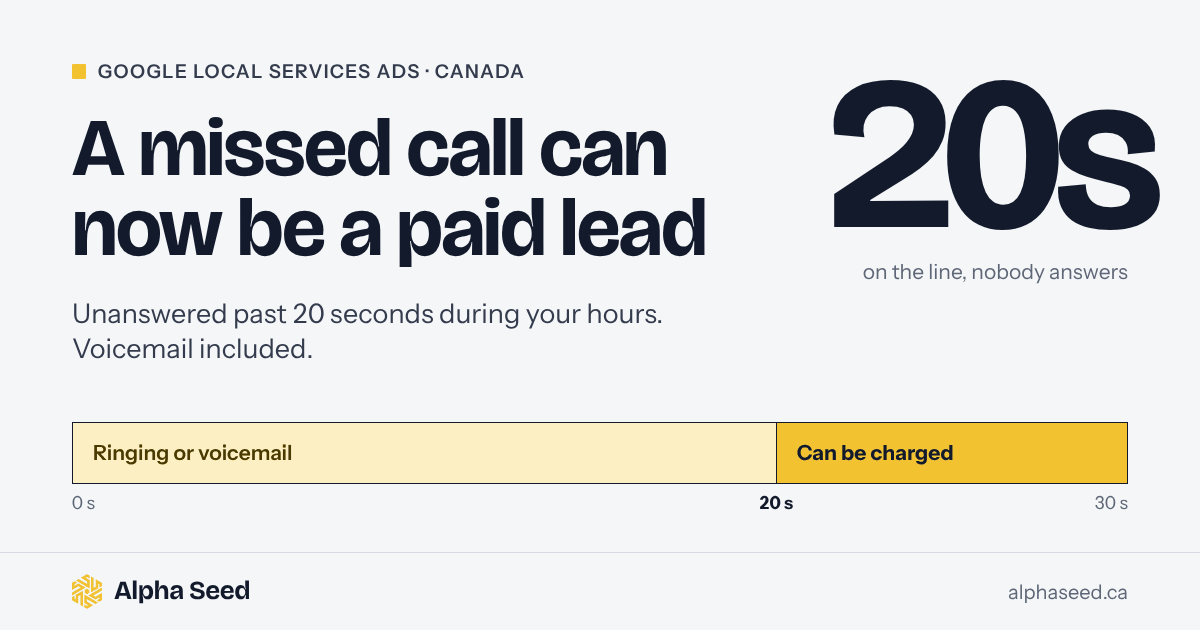
Google can now charge you for a Local Services Ads call you never answered. If the call comes in during your business hours and your ad schedule, and the caller stays on the line for more than 20 seconds, it can count as a paid lead, and voicemail doesn't get you out of it.
This guide is for owners of HVAC, plumbing, garage door and other trades running these ads in Calgary and across Canada. If you’re new to them, start with our plain guide to Local Services Ads in Canada. If the phone is the real problem, here’s how an AI front desk handles the calls you can’t reach.
What changed this fall
Before this change, a missed call with no voicemail usually became a lead only if you got back to the customer. Now the missed call itself can be the lead. You don’t have to speak to the person, and Google doesn’t need you to call back.
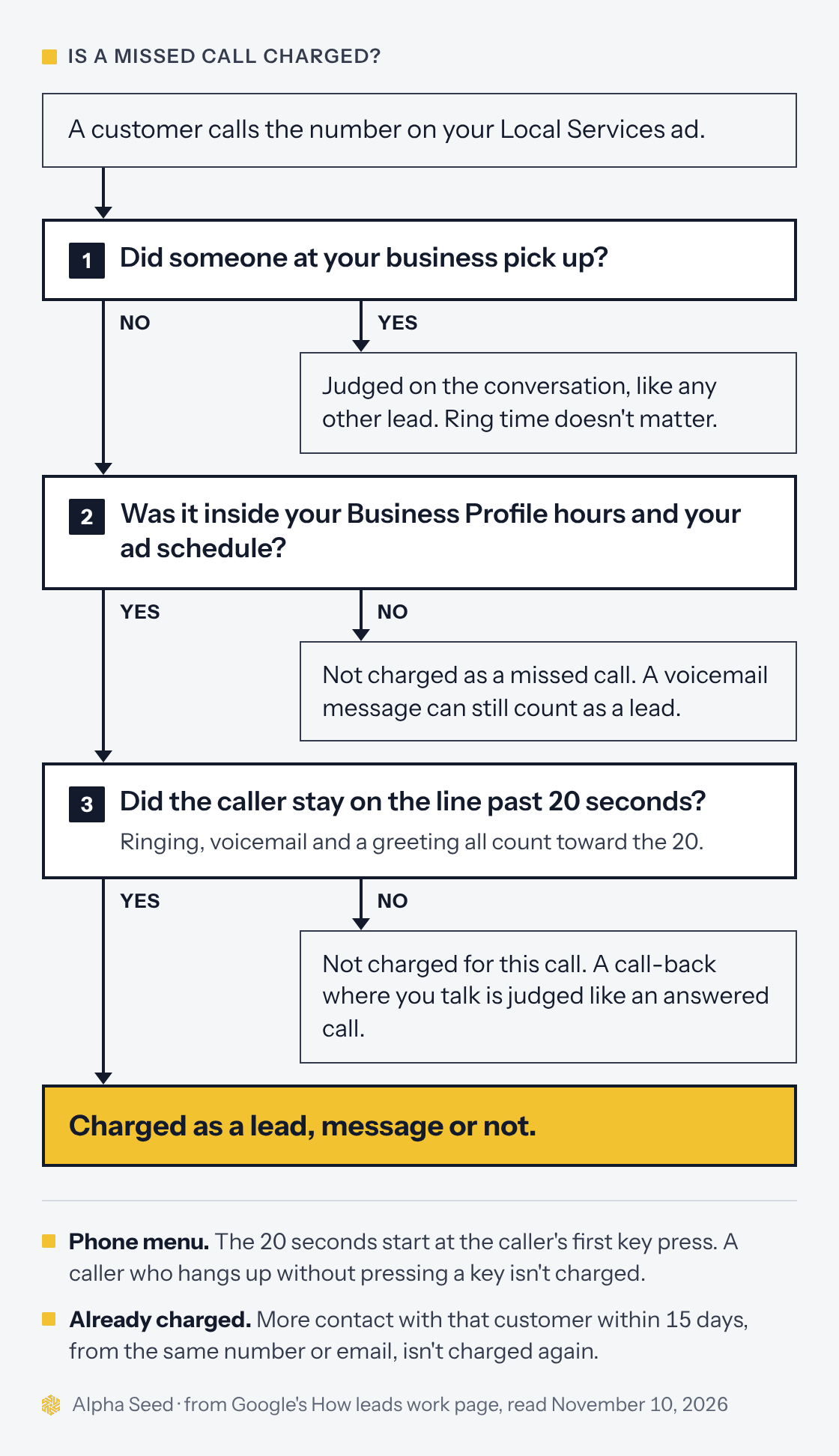
Here’s how the rule plays out case by case, based on Google’s current How leads work page:
| What happens on the call | Does Google charge? |
|---|---|
| You pick up, even after 20 seconds of ringing | Judged on the conversation, not the ring time |
| Nobody answers, caller hangs up within 20 seconds | Not for that call. If you call back and talk, that’s judged like an answered call |
| The same customer calls again later and that call meets the rules | Yes, even though the first call didn’t count |
| Nobody answers during your hours and ad schedule, caller stays on past 20 seconds | Yes |
| Voicemail or a greeting picks up during your hours, caller stays on past 20 seconds | Yes, whether or not they leave a message |
| Phone menu, caller hangs up without pressing a key | No, even if the menu ran past 20 seconds |
| Phone menu, caller presses a key, then nobody answers for 20 seconds | Yes. The timer restarts at the first key press |
| Unanswered call outside your hours or outside your ad schedule | Not under the missed-call rule. Unanswered calls are only charged inside both |
| Customer leaves a message after hours | It may still count. Google lists a voicemail from a customer as a valid lead, with no hours limit |
| You’ve been charged, then the same customer gets in touch again within 15 days from the same number or email | Not charged again |
Two of those lines matter most. Your “business hours” are the hours in your Google Business Profile. And voicemail, which most trades treat as cover, no longer needs a message to count: a pickup that runs past 20 seconds can be charged on its own.
Does this apply in Canada?
Plan for yes. Google’s email to some advertisers gave October 1 as the date and, as PPC Land reported, set no country limit. One report says at least one advertiser outside the US was given November 1. Both dates have passed, and the help page we read with Canadian language and country settings carries the rule with no Canadian exception.
We couldn’t find a Canada-only notice from Google, so check your own account. Search your inbox for an email with the heading “Upcoming changes to lead charge policy” to see your date. Not every advertiser got one, so if you can’t find it, go to the next step anyway. Open the Leads page, find a call you know you missed in the past few weeks, and read its Charge Status.
Don’t confuse this with the other 2026 change. Google is moving Local Services Ads into Google Ads, starting with selected US advertisers, and says non-US accounts move in 2027. The billing rule didn’t wait for that.
What a missed call costs you now
A missed call can now hit you in two places: the bill and your position on the page.
The bill is simple arithmetic: missed calls that ran past 20 seconds, times your lead price. Here’s an example with round numbers. Every figure in it is an assumption, not a statistic. Say a shop gets 60 Local Services Ads calls a month at $50 a lead, and 16 of them ring out past the 20-second mark with nobody answering. That’s up to $800 a month, if Google prices those calls like any other lead and you never reach those callers. Each real conversation would then cost about $68, not $50. Google sets lead prices by location, job type, type of lead and bidding mode, and its help page doesn’t say how missed calls are priced.
How common is that? Invoca, which sells call-tracking and AI agent software to home service companies, published 2026 benchmarks from its own customers’ calls. It found 52% of callers spoke with a person overall, and 73% on calls lasting more than 30 seconds. Reported by trade, HVAC was at 34% and plumbing at 74%. Those are not Calgary numbers, and a call no person answered isn’t always a charged call, since an after-hours call outside your schedule doesn’t count. Time your own phone instead of trusting anyone’s average.
The second cost is your spot on the page. Google lists responsiveness among the things that decide where your ad shows, and says missed calls may hurt it.
Five things to change this week
1. Make your hours true. Unanswered calls are only charged where your Business Profile hours and your ad schedule overlap, so that overlap is the window you’re paying for. Google’s lead rules read the hours in your Business Profile, and the Local Services dashboard also has a Business hours card under Profile & Budget, so check both. If the listing says you’re open when nobody can pick up, fix who picks up before you trim the listing. Those hours also tell customers when to call, so cutting them can cost you real calls.
2. Line up your ad schedule, then think before you cut. Ad scheduling lets you run all day, only during business hours, or on custom hours. If nobody’s on the phones from 6 to 8 a.m., you can drop those hours. Before you do, look at which hours your booked jobs actually come from. Demand swings hard here: furnace-repair searches in the Calgary area went from 390 in August to 2,900 in December, so a schedule that worked in summer may not fit January.
3. Stop treating voicemail as cover, and call back fast. During business hours, a voicemail pickup can be charged once the caller stays past 20 seconds, message or not. Once you’ve paid for that lead, return the call right away. Follow-up calls and messages with that customer aren’t charged again if you’re in contact within 15 days, so the call-back costs you nothing extra.
A missed-call text helps too. It won’t undo a charge, but it can stop the caller from dialling the next shop. Keep Canada’s anti-spam rules in mind: someone who calls about a job has likely made an inquiry, implied consent after an inquiry lasts up to six months, and a commercial message needs your business name, contact details and a way to unsubscribe. We aren’t lawyers, so check the wording of your own texts.
4. Time your own phone, then give overflow somewhere to go. Call your regular business line from a cell, not the number in the ad, at 7:45 a.m., noon and 4:30 p.m. on a busy day. Count the seconds until a person answers, and note how often nobody does. Picking up late doesn’t trigger a charge by itself. The charge comes when a caller waits past 20 seconds and nobody answers. If that’s happening often, you have three options:
| Option | Works best for | Watch for |
|---|---|---|
| Dispatcher or office staff on a second line | Daytime rushes | One person can only take one call. Wages run whether the phone rings or not |
| Human answering service | Nights and overflow | Often takes a message rather than booking the job. Ask how they bill and what happens above your plan |
| AI front desk | Nights, overflow, booking | Needs a fact sheet you’ve approved and real testing before it takes a customer’s call |
If you’re weighing the AI option, here’s what an AI receptionist costs in Canada and what to check.
Whichever you pick, write down what counts as an emergency. Real emergencies should reach your on-call person, and a caller who smells gas or has a carbon monoxide alarm going off should be told to get out and call 911.
Our Starter plan is $500 a month and includes after-hours and overflow answering with call tracking. Growth runs $1,500 to $4,000 a month by scope and adds 24/7 answering that books into your calendar. Both are in CAD, plus GST, and start with a 90-day paid pilot, which means three monthly invoices. Ad spend is separate and goes to Google from your own account. Neither plan lowers what Google charges you. An answered call is still a paid lead.
5. Read your Leads page every week. The Charge Status column shows Charged, Not charged, In review or Credited. Google says it keeps assessing lead quality for 30 days and may credit leads it judges poor, duplicate or invalid. It also says it may occasionally credit leads you report as poor quality, so fill in the survey on any bad lead. Treat a credit as a bonus, not as money you can count on.
A phone menu, and why we’d go slowly
If callers must press a key, you aren’t charged when they hang up without pressing, and the 20-second timer restarts at the first key press. Later key presses don’t reset it. That screens out robots and wrong numbers, but some real customers will hang up too, and at 11 p.m. with no heat they may not stay for a menu. Google already filters some spam on its own. We’d only add a menu if junk calls are a proven problem in your account.
When this isn’t worth fixing
Not every shop should spend money on this.
- You don’t run Local Services Ads. This rule covers call leads from those ads. It doesn’t touch regular Google Ads or your organic Maps listing.
- You get a handful of these calls and answer most of them. Fix your hours, tighten the schedule and leave it there. A paid service won’t pay for itself over a few missed calls.
- You’re booked out for weeks. Pause the ad or cut the schedule back. Paying for leads you can’t serve makes no sense, however well the phone gets answered.
What we’d do first
Before you change anything, pull your leads since the date in your notice, or the past 30 days if you never got one. Count the ones marked Charged where nobody spoke to the customer, and multiply by your average lead price. That’s what you paid for no conversation.
Answering more calls won’t shrink Google’s bill, because answered calls are charged too. The return is in the jobs you book from calls you’d otherwise have lost. So compare what cover would cost with what those jobs would have been worth. If the gap is big, fix it this week. If it’s small, fix your hours and move on. If you’d rather not watch this yourself, we run Local Services Ads as part of our Growth plan.
For a second opinion on your phones, our free scan calls your line outside your posted hours, records what happens, and shows where you stand on Google Maps across your area. It’s an after-hours test, so it won’t catch daytime misses. The calls you time yourself do that. You’ll hear back within one business day, and there’s no sales call unless you ask for one.
Sources
- Google, How leads work, read November 5 and again November 10, 2026.
- Google, About ad rankings, About ad scheduling and Edit your business hours, read November 5, 2026.
- Google Ads Help, Local Services Ads transition to Performance Max campaigns with pay-per-lead goals, read November 5, 2026.
- Search Engine Roundtable, Google To Charge For Missed & Subsequent Calls On LSAs, August 25, 2026.
- PPC Land, Google charges Local Services advertisers for missed calls over 20 seconds, August 25, 2026, and its report on the Invoca figures.
- TechWyse, Google to Bill Local Services Ads Advertisers for Unanswered Calls, August 27, 2026.
- Digital Stride, October 2026 Google LSA Update, read November 5, 2026.
- Government of Canada, Getting consent to send email, read November 5, 2026.
- Invoca, Home Services Lead Conversion Benchmarks Report 2026, July 2026.
- Google Keyword Planner, Calgary area, September 2025 to August 2026, collected October 12 and 13, 2026.
This guide is general information, not advice for your specific situation, and Google’s rules change. Check Google’s current documentation before relying on any detail here.
Missed call charge questions
Am I charged if I pick up after 20 seconds?
Not because of the ring time. The 20-second rule only applies to unanswered calls. If you pick up, Google judges the call on the conversation.
If I miss a short call and call back, am I charged?
The short missed call isn’t charged on its own. If you call back and speak with the customer, Google treats that like an answered call, and you’re charged once if it’s a valid lead. A later call from that customer that meets the rules can also be charged, even though the first one didn’t.
Does voicemail count as a missed call?
Google treats voicemail or an automated greeting during your business hours as a connected call. It’s charged if the caller stays on for more than 20 seconds, whether or not they leave a message. A voicemail from a customer is also on Google’s list of valid leads, and that line has no hours limit.
Will I pay twice if the same customer calls again?
Not for a lead you’ve already been charged for, as long as you’re in contact within 15 days and they use the same phone number or email. After 15 days with no activity, a new call creates a new lead.
Can I dispute a missed call charge?
Google’s How leads work page doesn’t describe a formal dispute process. It says lead quality is assessed for 30 days and that leads it judges poor, duplicate or invalid may be credited. It also says it may occasionally credit leads you report as poor quality, so use the survey on the Leads page when a lead was bad.
Does an AI receptionist count as answering?
Google hasn’t said. Its closest wording covers automated greetings, which are charged if the caller stays past 20 seconds, so assume a call your AI assistant takes can be charged. The difference is what you get for the money: a booked job or a clear message instead of a voicemail.
Keep reading
-
How to ask for Google reviews: Google's rules and CASL
How to ask customers for Google reviews in Canada without breaking Google's rules or the anti-spam law, with a request you can send after every job.
-
AI receptionist in Canada: what it costs and what to check
What an AI receptionist costs in Canada, with prices checked November 10, 2026, and the recording, privacy and emergency checks to make before it answers.
-
Google Local Services Ads in Canada, explained for business owners
How Google Local Services Ads work in Canada in 2026: who is eligible, the Google Guaranteed and Google Screened badges, pay-per-lead pricing, the documents you need, how Google credits bad leads, and the 2026 move into Performance Max. Written for Calgary and Alberta trades.
See where your calls and your Google profile stand
The free scan shows where you rank on Google Maps across your service area and what happens when someone calls you after hours. One email, no obligation.