Restoration companies in Calgary: get the first call after a cold snap
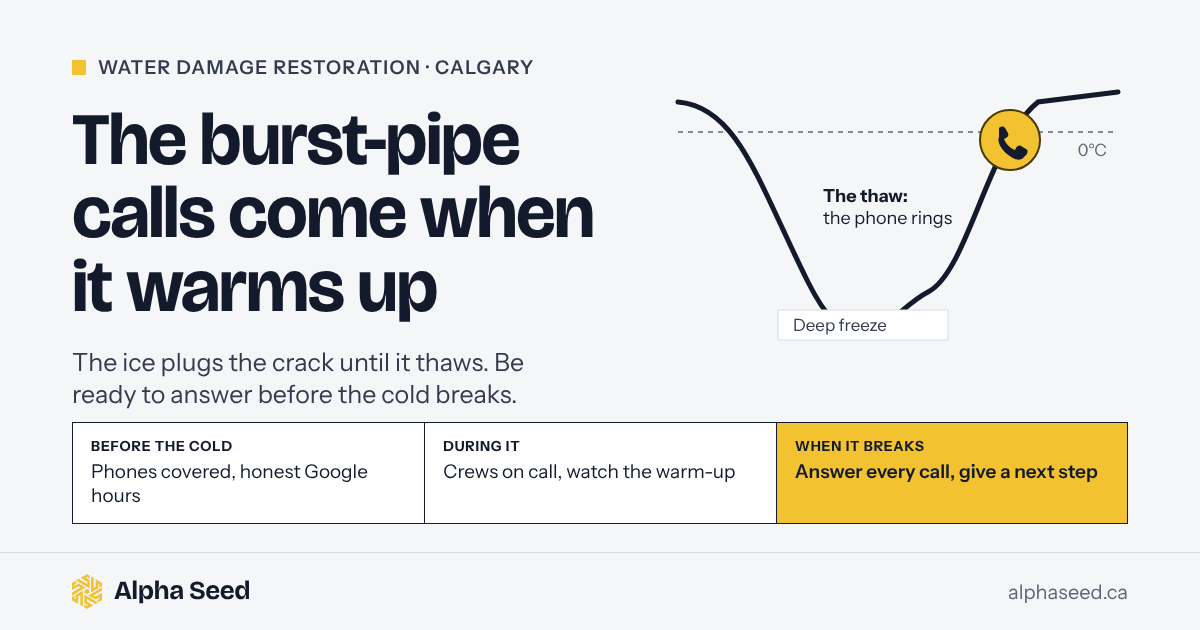
In Calgary, many burst-pipe calls come when the cold breaks, not at the bottom of it, because the ice that plugged a cracked pipe has to thaw before the water shows. The restoration company that gets the job is usually the one that answers first and tells a panicked homeowner what to do, so set up the phones, the script and your Google hours before the forecast turns.
This guide is for owners of water damage and restoration companies in Calgary and the towns around it. It covers why the calls bunch up when the cold breaks, what a homeowner needs to hear in the first minute, and what to set up before the next deep freeze. If nights and overflow are where you lose calls, here’s how our AI call answering covers them.
Why the calls come after the cold breaks
A frozen pipe can crack without leaking. Calgary Fire Department’s Carol Henke told Global News in January 2024 that the ice “can act as a plug”, and that “it’s not until that ice plug thaws that the break in the line then makes itself known.” She expected more of those calls as the weather warmed.
So the busiest days for a restoration company often aren’t the coldest ones. They’re the days after, when the temperature climbs back toward zero and homeowners walk into a wet basement.
The bill from one of these events is large. The Insurance Bureau of Canada estimated that the January 2024 deep freeze caused over $180 million in insured damage across British Columbia, Alberta and Saskatchewan, mostly “widespread water damage caused by frozen and burst pipes.” The figure is an estimate from CatIQ. About 70% of the claims were personal property claims, mostly from households rather than businesses. CBC reported that Alberta alone accounted for about $30 million.
The cold arrived on January 12 that year, after a mild start to the winter. That’s the pattern to plan for: a short window between the forecast and the rush.
What the caller is going through
The person on the line has water on the floor and doesn’t know what to do first. The City of Calgary tells residents that if the house or basement is flooding, they should turn off the main shut-off valve and call 311. It also says 311 response “may be delayed due to high volumes” and that a plumber at their own expense is the faster option.
The City is clear about who pays for what. The property owner is responsible for repairs on private property, including a damaged or frozen water meter. That’s why many of these calls go to private plumbers and restoration companies, and why the first company that picks up and sounds like it knows what to do has an edge.
Two things follow for your phone:
- The first minute is advice, not sales. If the caller hasn’t shut off the water, help them find the valve, but only if they can reach it without stepping into water near outlets or the electrical panel. The City says it’s often near the water meter where the line enters the house, usually in the basement. In a condo or townhome, the City says to call the building owner or manager. A company that stops the damage on the phone is the company the homeowner trusts with the rest of the job.
- Speed beats polish. A homeowner standing in water will call the next listing if you don’t answer. Many won’t wait for a callback tomorrow morning.
A triage script for the first call
Whoever answers, whether it’s you, a dispatcher, an answering service or an AI assistant, should follow the same short script. Here’s the one we’d start from.
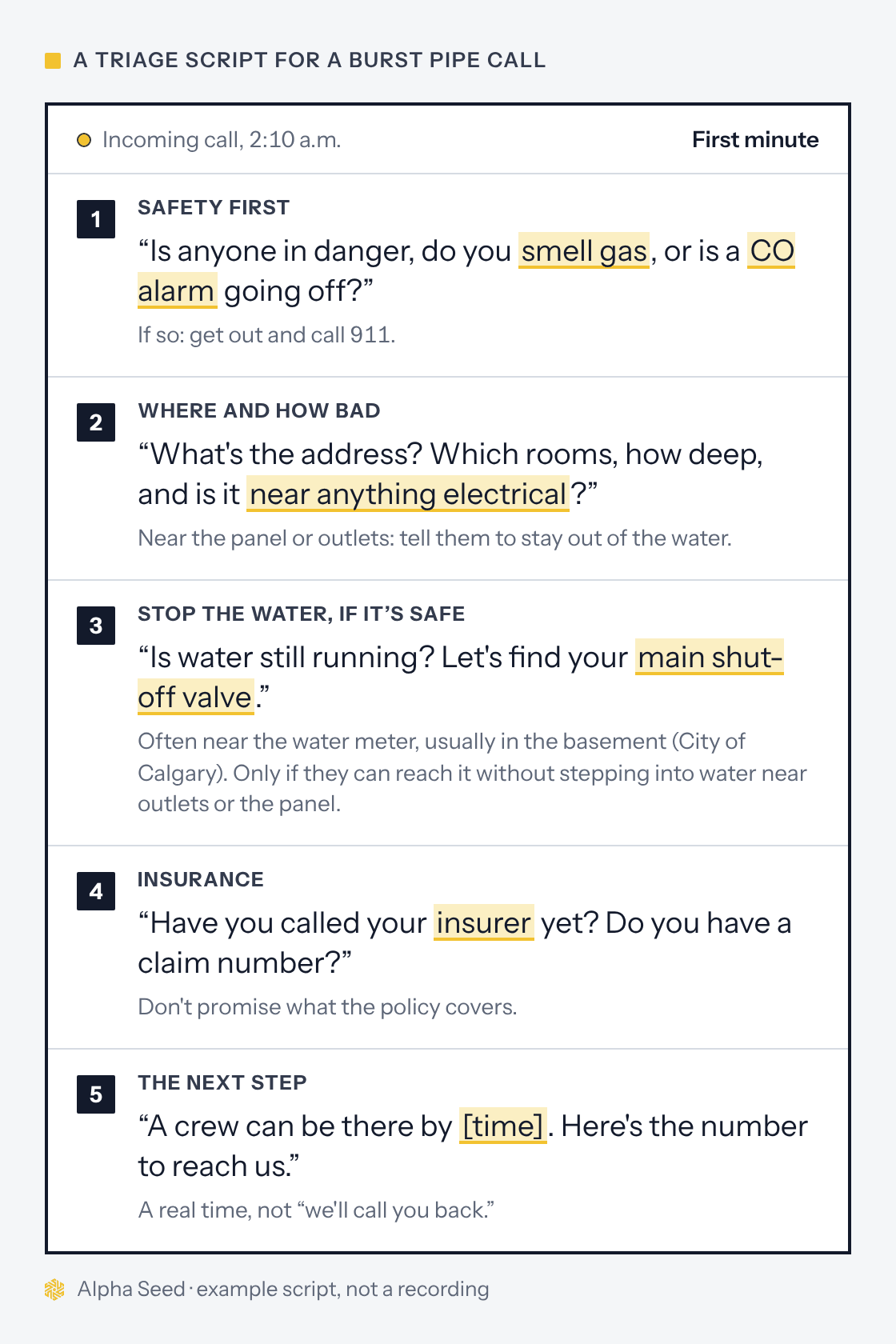
A few notes on the steps:
- Safety first. A caller who smells gas, or has a carbon monoxide alarm going off, should be told to get out and call 911 before anything else.
- Water near electrical. Ask before you send anyone to the valve. If the water is near the panel or outlets, tell the caller to stay out and wait for the crew. Don’t try to give electrical advice over the phone.
- Insurance. Ask whether they’ve called their insurer. Don’t promise what a policy covers. The Insurance Bureau of Canada notes that frozen-pipe coverage can be limited when people are away from home in the heating season, so leave that conversation to the insurer.
- The arrival window. Give a real time your dispatcher can keep, even if it’s “a crew can be there by 7 a.m.” A vague “we’ll call you back” often loses the job.
If calls are recorded, tell the caller and say why. Our guide to what an AI receptionist costs and the rules that apply in Canada covers the recording notice and the other checks.
Five things to set up before the forecast turns
The window between the forecast and the rush is short. Environment Canada issues cold warnings when the temperature or wind chill is much colder than normal, at different thresholds depending on where you live. Treat the first one of the winter as your deadline for the list below.
1. Know who answers every call, day and night. Write down who has the phone at 2 a.m. on a Sunday, who takes overflow when two calls come in at once, and who gets the call when that person is on a job. If the answer is “voicemail”, that’s the gap. Cover can be a person on call, a human answering service or an AI assistant; our cost comparison has prices for each.
2. Put the script in front of whoever answers. The five steps above, plus your service area, your after-hours rate if you charge one, and what you do and don’t take on. A new dispatcher or an answering service can’t guess any of that.
3. Make your Google hours true. Google’s guidelines for Business Profiles ask for your “regular customer-facing hours of operation.” List 24 hours only if someone answers and can dispatch around the clock. For holidays, use special hours so your regular hours stay intact. If you’d rather have someone else keep the profile right, that’s part of our Google Business Profile service.
4. If you run Local Services Ads, check what a missed call costs. Google can now charge for an unanswered call during your business hours and ad schedule once the caller stays on past 20 seconds, voicemail included. In a rush, count how many calls ring out. Here’s what the missed-call charge means and what to change.
5. Track the calls, including the ones you missed. After the last cold snap, could you say how many calls rang out, at what hours, and how many became jobs? If not, you can’t tell whether the fix worked. A tracked number on your website and Google profile answers that. Call tracking is part of both of our plans.
Before the cold, during it, and when it breaks
| When | What to do |
|---|---|
| Before the first cold warning | Test your phones after hours, set honest Google hours, brief whoever answers, check your tracked numbers work |
| During the deep freeze | Confirm who’s on call each night, keep drying equipment and crews ready, watch for the warm-up in the forecast |
| When the cold breaks | Expect the rush. Every call answered, a next step on every call, a callback list worked first thing each morning |
| A week later | Count calls, missed calls and jobs. Fix whatever broke before the next one |
When this isn’t your problem
Not every restoration company needs to change anything.
- You already answer every call. Test it: call your own line at 11 p.m. and at a busy midday hour. If a person who can dispatch picks up each time, you’re in good shape.
- Most of your work comes through insurer or property manager referrals. Then the homeowner’s late-night call matters less to you than those relationships, and your effort belongs there.
- You don’t do emergency work. If you only take scheduled drying or rebuild work, don’t pretend otherwise on Google. Say when you’re open and point emergencies elsewhere.
What we’d do first
Pull your phone records for January 2024, or for whichever cold snap hit you hardest since. Count the calls that came in after hours and the ones nobody answered, then look at the days just after the cold broke. That’s the size of the gap.
For a check of your own line, our free scan calls your business outside your posted hours, records what happens and shows where you stand on Google Maps. You’ll hear back within one business day, and there’s no sales call unless you ask for one. If you’d like the phones covered for you, we have two plans: Starter includes after-hours and overflow answering, and Growth adds 24/7 answering that books into your calendar. We quote each company after a 20-minute demo, and both start with a 90-day paid pilot, then go month to month with 30 days’ notice. Book a demo.
Sources
- Global News, Calgarians clean up after burst pipes, water main breaks, January 19, 2024, read November 11, 2026.
- Insurance Bureau of Canada, Western Canada deep freeze causes over $180 million in insured damage, March 11, 2024, with figures from CatIQ, read November 11, 2026.
- CBC News, January deep freeze cost $180M in insured damages across Western Canada, read November 11, 2026.
- City of Calgary, Protect your water lines and meter from freezing, updated November 4, 2026, read November 11, 2026.
- Environment and Climate Change Canada, Extreme cold and cold warnings, read November 11, 2026.
- Google Business Profile Help, Guidelines for representing your business on Google and How to set special hours, read November 11, 2026.
This guide is general information, not advice for your situation. Google’s rules and the City’s guidance change, so check the current pages before relying on any detail here.
Restoration phone and lead questions
When do burst pipe calls come in Calgary?
Often when the weather warms up after a deep freeze. Calgary Fire Department told Global News in January 2024 that ice in a frozen pipe acts as a plug, and the break only shows once that plug thaws. Plan your phone cover for the days after the cold breaks, not just the coldest night.
Should a restoration company answer the phone 24/7?
If you sell emergency water damage work, yes, or at least have every call reach someone who can give the caller a next step and an arrival window. A voicemail at 2 a.m. sends the homeowner to the next listing. If you don’t dispatch crews at night, say so plainly and give a callback time.
Can I list my business as open 24 hours on Google?
Only if it’s true. Google’s guidelines ask for your regular customer-facing hours of operation. List 24 hours only if someone answers and can dispatch around the clock. If nobody answers at night, listing 24 hours sets up the caller and, if you run Local Services Ads, can cost you paid leads nobody spoke to.
What should we tell a homeowner whose pipe just burst?
The City of Calgary’s advice is to turn off the main shut-off valve and call 311. The valve is often near the water meter where the line enters the house, usually in the basement. They should only go for it if they can reach it without stepping into water near outlets or the panel. In a condo or townhome, the City says to call the building owner or manager. Anyone who smells gas or has a carbon monoxide alarm going off should get out and call 911. Then get the address, how far the water has spread, and whether they’ve called their insurer.
How do restoration companies get more water damage leads?
Most advice on this question is about SEO and ads. In a Calgary cold snap the bigger leak is usually the phone: calls that ring out at night, a Google profile with hours nobody keeps, and no record of which calls you missed. Fix those before you buy more traffic.
Keep reading
-
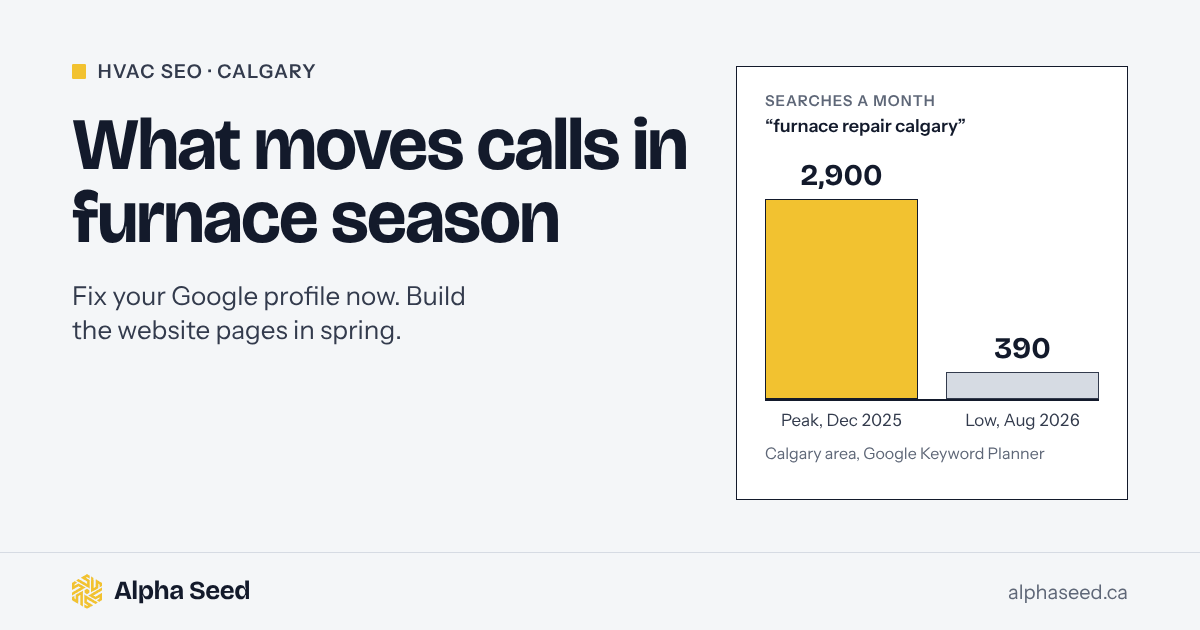
HVAC SEO in Calgary: what moves calls in furnace season
Calgary furnace searches rise about sevenfold by December. What an HVAC company can change on Google this winter, and the website work to start in spring.
-
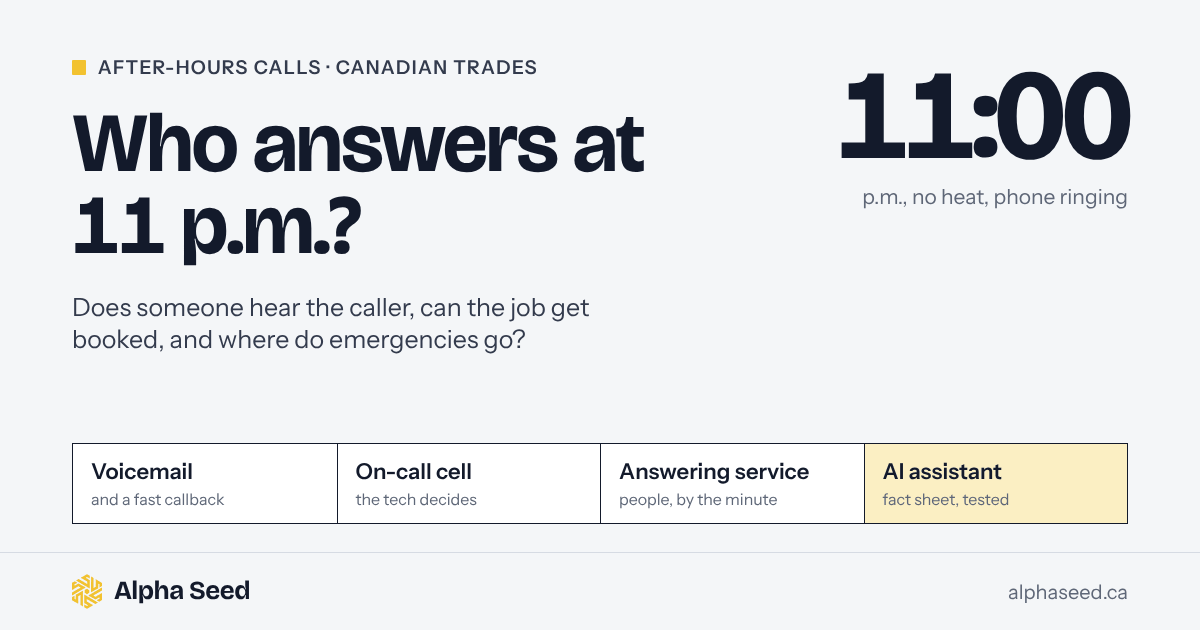
After-hours answering for trades in Canada: voicemail, a service or AI
Voicemail, the on-call tech's cell, an answering service or AI: how Canadian trades can cover after-hours calls, what each costs and where emergencies go.
-
How to ask for Google reviews: Google's rules and CASL
How to ask customers for Google reviews in Canada without breaking Google's rules or the anti-spam law, with a request you can send after every job.

See where your calls and your Google profile stand
The free scan shows where you rank on Google Maps across your service area and what happens when someone calls you after hours. One email, no obligation.